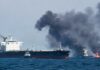
In a significant development affecting global markets, oil prices dropped sharply while stock markets saw gains following President Donald Trump’s announcement regarding the ongoing conflict with Iran. Trump indicated that the tensions could conclude, and the Strait of Hormuz would be accessible to all if Tehran agreed to a deal with Washington. This potential resolution comes after a period of heightened strain, where the strait, a crucial passage for about 20% of the world’s oil supply, was blocked by Iran, contributing to an international energy crisis.
The President’s statement on social media suggested that if Iran adhered to previously discussed agreements, the operation known as “Epic Fury” could end, and the blockade would permit open access to the Strait of Hormuz, inclusive of Iranian vessels. However, Trump warned that failure to reach an agreement would result in escalated military actions, stating that any bombing would occur at a more intense level than before. This announcement followed Trump’s decision to temporarily halt “Project Freedom,” an operation escorting ships through the strait.
Iran’s initial response came from the Revolutionary Guards’ Navy, which assured that transit through the strait would remain secure, noting the shift in US operations as a catalyst for implementing new procedures. Despite the President’s pronouncements, Iran characterized the US proposal as merely an “American wishlist” rather than a tangible reality. Nevertheless, these developments initially sent Brent crude oil prices plunging by 11% to $97 a barrel, marking the first dip below $100 since late April. Likewise, wholesale gas prices and airline stocks experienced fluctuations, reflecting the market’s reaction to potential easing of travel and energy costs.
Although reports suggested that the White House was nearing a one-page memorandum of understanding with Iran to halt the conflict, which bolstered early optimism, oil prices later rebounded partially. By the end of the day, they settled at a 7.3% decline, trading at $101.83 per barrel. The initial surge in oil prices, peaking at $126 a barrel last week, was driven by concerns over a protracted US blockade of Iranian ports and stalled peace negotiations.
The news brought a positive shift in European stock markets, with the UK’s FTSE 100 index rising by 2%, and further gains observed in France’s Cac 40 and Germany’s Dax, increasing by 3% and 2.1%, respectively. Additionally, MSCI’s All-Country World Index reached a new record, alongside significant advances in its emerging markets benchmark and the broadest index of Asia Pacific shares outside Japan, which climbed by 2.5%.