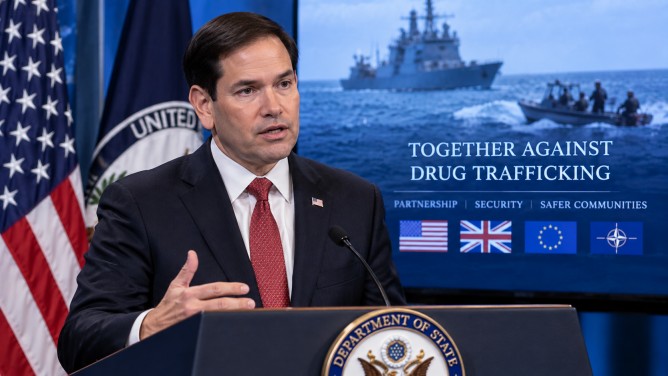
During a recent visit to Ecuador, US Secretary of State Marco Rubio emphasized a strategy shift towards enhanced collaboration with Latin American nations to tackle drug trafficking. Rubio pointed out that the United States, while still willing to deploy military force against vessels when deemed necessary, is now actively seeking joint operational agreements with countries such as Ecuador and Colombia. These collaborations would focus particularly on operations within their territorial waters, adhering to local laws and regulations.
This announcement comes in the context of an ongoing US military initiative targeting boats suspected of drug trafficking activities. The campaign has seen a recent incident in the Caribbean Sea, where a US strike reportedly resulted in the deaths of three individuals. To date, the military operations have accounted for at least 230 fatalities across 69 separate actions since the effort commenced in September 2025.
Rubio noted that future military engagements would be evaluated individually, with decisions based on the specific threat level and the location of the suspect vessel. He stressed that by fostering cooperation with regional governments, the US aims to disrupt and eventually dismantle the networks and routes used for drug trafficking in the region.
This pivot towards regional cooperation marks a significant policy evolution from earlier US strategies, which faced criticism for their unilateral nature. Previously, under the Trump administration, the US conducted independent strikes on vessels, accusing those aboard of being associated with “narco-terrorists.” The new approach aims to address these concerns by involving partner nations in the decision-making and operational processes.