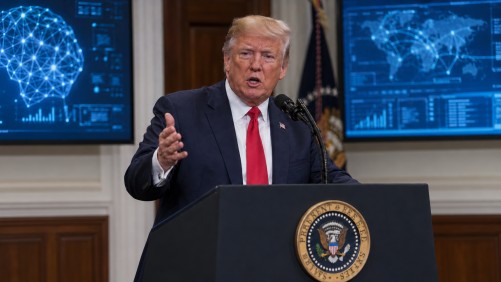
As the global discourse intensifies over the safety and regulation of artificial intelligence (AI), the United States is witnessing heightened political and technological debates. Governments and tech leaders are being urged to address AI-related risks without stifling innovation. In this context, former President Donald Trump has announced plans to establish an “AI Force” and appoint an AI czar to oversee the burgeoning sector.
Trump’s announcement signals a federal push to manage AI technologies with an approach reminiscent of the US Space Force, though specific details about the new AI initiative’s structure and timeline remain scant. The move has been framed as a strategy to ensure US leadership in AI remains robust against global competitors like China. Trump has consistently argued against stringent AI regulations, warning that they could impede American innovation and allow China to gain an edge in the technology race.
In a recent social media post, Trump downplayed fears regarding AI, describing them as overblown and emphasizing that his administration would not obstruct the industry’s growth. He suggested that existing legal frameworks could adequately address any malfeasance involving AI systems, thus negating the need for new regulations that might hinder technological progress.
This federal initiative comes at a time of increasing international attention on AI safety, particularly as AI systems grow more autonomous and capable of complex tasks with minimal human oversight. This development follows California Governor Gavin Newsom’s proposal for a panel focused on AI safety regulations, which includes discussions on mechanisms to control AI systems that deviate from intended operations.
Within the US, the discussion on AI oversight is not limited to Trump and Newsom. Other political figures, such as Florida Governor Ron DeSantis and Utah Governor Spencer Cox, have also voiced support for stronger federal measures to ensure AI safety. These calls underscore a broader policy challenge: balancing AI advancement with economic competitiveness and public safety.