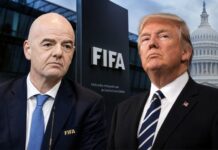
The United States has come to the defense of Argentina’s national football team following a controversial display of a banner asserting Argentina’s claim to the Falkland Islands during their celebration after defeating England in the World Cup semi-final. Andrew Giuliani, who leads the White House’s FIFA taskforce, emphasized the American support for freedom of expression. Meanwhile, officials from the United Kingdom have criticized the gesture, urging FIFA to consider whether it violates the organization’s rules that prohibit political statements in football. In response, FIFA has stated that it is reviewing the situation as part of its disciplinary protocols.
The display of the banner has reignited the simmering tensions surrounding the sovereignty of the Falkland Islands, a long-disputed territory between Argentina and the UK. The government of the Falkland Islands has labeled the display as inappropriate, urging FIFA to maintain its stance on separating politics from sports. The incident has highlighted the enduring sensitivity and emotion associated with the Falklands issue, which has been a point of contention between the two nations for decades.
Giuliani’s comments reflect a nuanced position from the United States, balancing diplomatic relations with both the UK and Argentina while underscoring the principle of free speech. The situation places FIFA in a challenging position as it tries to adhere to its policies that aim to keep political issues out of the sporting realm, yet recognizes the complexity of enforcing such rules in a global event like the World Cup.
As FIFA proceeds with its examination of the incident, the football community and international observers are keenly watching how the organization will navigate this delicate issue. The outcome could have implications for how political expressions are managed in future sporting events, particularly those with a global audience. The reverberations from this incident continue to underscore the powerful intersection of sports, national identity, and political expression on the world stage.